Guides
How long does parking lot striping take per parking stall?
Parking lot striping time is 3 to 5 minutes of machine time per stall, but a full lot takes 2 to 4 days with layout, drying and traffic control.
What to take away
- Machine time per standard 9-by-18-foot stall runs roughly 3 to 5 minutes for a walk-behind airless sprayer, and about 1 to 2 minutes for a ride-on striper on an open lot.
- A 100-stall lot is usually a 2 to 4 day job once layout, layout verification, drying and traffic phasing are counted.
- Paint drying time is the blocker that most often pushes a job into a second day, and it is set by product data sheets and surface temperature, not by the crew's pace.
- Accessible stalls, fire lanes and curb painting add time per stall rather than per foot, so they rarely scale with the rest of the lot.
- Weather and pavement temperature decide the season more than the calendar does.
The short version
Striping time is measured two ways, and the two numbers are far apart. Contractors bid linear feet of stripe and count stalls. Property owners ask about stalls.
Stall striping time by method
- 3-5 minwalk-behind airless per stall
- 1-2 minride-on unit per stall
- 20 linear ftpaint per 9x18 stall
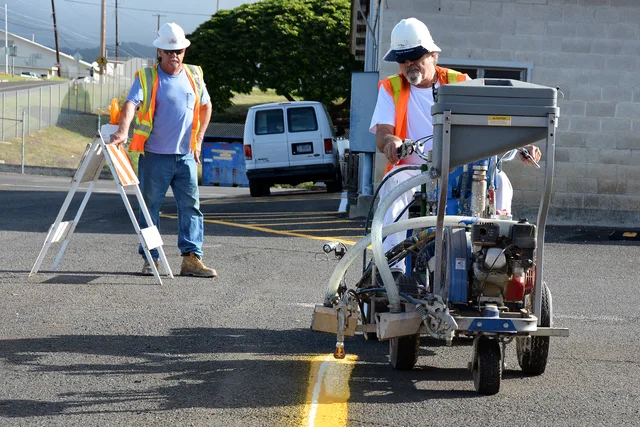
A single 9-by-18-foot stall needs about 20 linear feet of paint: two 18-foot side lines plus a 9-foot front line. At a typical walk-behind airless pace, that is 3 to 5 minutes of actual spraying. A ride-on unit on a clean, empty lot can cut that to 1 to 2 minutes.
That figure is machine time only. It excludes layout, stencil work, drying, and moving cones. Those are the parts that fill the day.
Phase by phase
| Phase | Typical duration | What it covers |
|---|---|---|
| Mobilization and setup | 30 to 90 minutes | Unload, stage cones, check pavement temperature and moisture |
| Layout and snap lines | 2 to 4 hours per 100 stalls | Chalk lines, string lines, measuring stall widths |
| Layout verification | 30 to 60 minutes | Re-measure accessible stalls and aisles before paint |
| Striping | 3 to 5 minutes per stall | Walk-behind or ride-on application |
| Stenciling and symbols | 15 to 30 minutes per symbol | Arrows, hatch, accessible symbols |
| Cure and reopen | 30 minutes to 4 hours | Depends on product and surface temperature |
Layout is the phase new contractors underestimate. A 100-stall lot with worn or missing lines can take half a day to re-establish before any paint goes down.
Striping job phase durations
- Mobilization30-90 min setup
- Layout2-4 hrs per 100 stalls
- Verification30-60 min re-measure
- Striping3-5 min per stall
- Stenciling15-30 min per symbol
- Cure30 min to 4 hrs
What has to finish before what
Layout verification must finish before striping starts. If a crew sprays first and measures later, accessible stalls that come out undersized have to be blacked out and redone, which adds a full day.
Required striping sequence
- Layout verification before striping
- Striping before stenciling
- Cure before vehicles return
The 2010 ADA Standards set the dimensions that verification checks against, and the Access Board's parking guide walks through access aisle and signage requirements stall by stall.
Cure must finish before vehicles return. Opening a lot early is the most common cause of a callback, and it is entirely a scheduling decision.
Where schedules slip
Slippage comes from four places, in rough order of frequency.
- Pavement that is too damp or too hot at the scheduled start, which pushes spraying to the next morning.
- Occupied stalls. Every car left in the work zone adds a return trip, and a lot at 30 percent occupancy can double the calendar time.
- Layout disputes. If the property manager disagrees with stall count or aisle width after lines are down, the crew repaints.
- Stencil inventory. Missing arrows or symbols mean a second visit for a job that was otherwise finished.
The worst case is a fully occupied retail lot with no overnight window. Crews then work in rolling phases of 20 to 30 stalls, and a 100-stall lot can stretch to 5 to 7 days.
That pattern is common at grocery-anchored centers where tenants will not accept a full closure. The cause is access, not production speed.
Seasonal and weather constraints
Water-based traffic paint generally needs surface temperatures above 50 degrees Fahrenheit and rising, and relative humidity low enough for the film to set. Oil-based and thermoplastic products have their own windows, which the FHWA pavement marking research documents by material and application temperature.
Below those thresholds, cure time stretches from under an hour to several hours, and overnight work becomes the only viable window. In northern states that narrows the season to roughly April through October. In the Sun Belt, summer heat pushes crews to early morning starts instead.
Rain is a hard stop. Paint applied to damp pavement can fail within weeks, so a forecast with afternoon storms usually means a morning-only schedule.