Guides
Parking lot striping equipment brands compared for 2027
Graco, Titan, Wagner, Trusco and EZ-Liner compared on pump type, coatings, parts availability and cleanout time for the 2027 parking lot striping season.
What to take away
- Graco, Titan, Wagner, Trusco and EZ-Liner are the five parking lot striping equipment brands most U.S. crews run. Each is built for a different job size.
- Airless piston machines (Graco LineLazer, Titan PowrLiner) hold pressure on long pulls. Diaphragm machines (Wagner) suit short runs and waterborne paint.
- Trusco and EZ-Liner sell walk-behind units with fewer parts and lower purchase prices. They suit small lots and startup crews.
- Parts route beats specifications. A machine with no local dealer is a season-long outage waiting to happen.
- Compare 2027 finalists on your own coating, your own pavement and a stopwatch, not on a spec sheet.
Graco, Titan, Wagner, Trusco and EZ-Liner compared
All five lines are airless. They split on pump type, the coatings they handle, how fast a part reaches you, and how long a cleanout takes at the end of a night. The table sets the five side by side.
Five striping brands compared
Graco
- Pump type
- Airless piston
- Coatings
- Water/solvent
- Parts route
- Dealer network
- Cleanout time
- 15-30 min
- Price band
- $4,000-$9,000
Titan
- Pump type
- Airless piston
- Coatings
- Water/solvent
- Parts route
- Distributor network
- Cleanout time
- 15-30 min
- Price band
- $3,500-$8,000
Wagner
- Pump type
- Diaphragm/piston
- Coatings
- Water, some solvent
- Parts route
- Hardware stores
- Cleanout time
- 10-20 min
- Price band
- Under $2,500
Trusco
- Pump type
- Airless walk-behind
- Coatings
- Water/solvent
- Parts route
- Used/aftermarket
- Cleanout time
- 10-20 min
- Price band
- $500-$2,500 used
Brands compared
Pump type
- Graco LineLazer V and IV
- Airless piston, one or two guns
- Titan PowrLiner 850 and 1650
- Airless piston, two guns
- Wagner diaphragm and piston units
- Diaphragm, piston on larger models
- Trusco walk-behind
- Airless, walk-behind
- EZ-Liner walk-behind and ride-on
- Airless, sold direct
Coatings
- Graco LineLazer V and IV
- Waterborne and solvent
- Titan PowrLiner 850 and 1650
- Waterborne and solvent
- Wagner diaphragm and piston units
- Waterborne, some solvent
- Trusco walk-behind
- Waterborne and solvent
- EZ-Liner walk-behind and ride-on
- Waterborne and solvent
Parts route
- Graco LineLazer V and IV
- Dealer locator on Graco's site, and a dealer in most metro areas
- Titan PowrLiner 850 and 1650
- Titan distributor network, often the same counters that stock Graco
- Wagner diaphragm and piston units
- Hardware and home-center channels, with fewer striping-specific counters
- Trusco walk-behind
- Used and aftermarket supply, simple parts stack
- EZ-Liner walk-behind and ride-on
- Factory direct, so shipping replaces a dealer counter
Cleanout time (typical)
- Graco LineLazer V and IV
- 15 to 30 minutes with a full flush
- Titan PowrLiner 850 and 1650
- 15 to 30 minutes
- Wagner diaphragm and piston units
- 10 to 20 minutes, smaller fluid section
- Trusco walk-behind
- 10 to 20 minutes
- EZ-Liner walk-behind and ride-on
- 15 to 30 minutes on walk-behind
Price band (typical, new)
- Graco LineLazer V and IV
- $4,000 to $9,000
- Titan PowrLiner 850 and 1650
- $3,500 to $8,000
- Wagner diaphragm and piston units
- Under $2,500 for diaphragm
- Trusco walk-behind
- $500 to $2,500 used
- EZ-Liner walk-behind and ride-on
- Walk-behind under $4,000
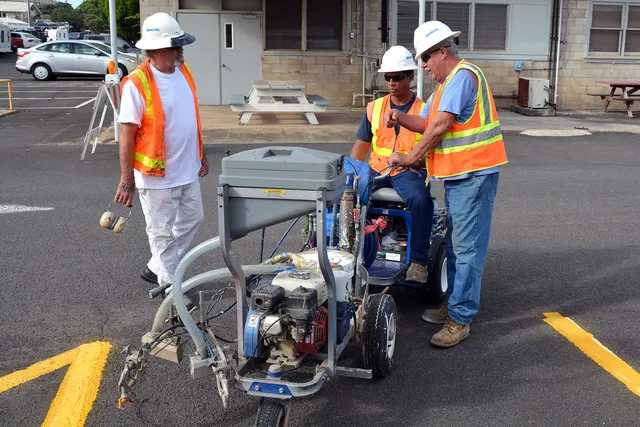
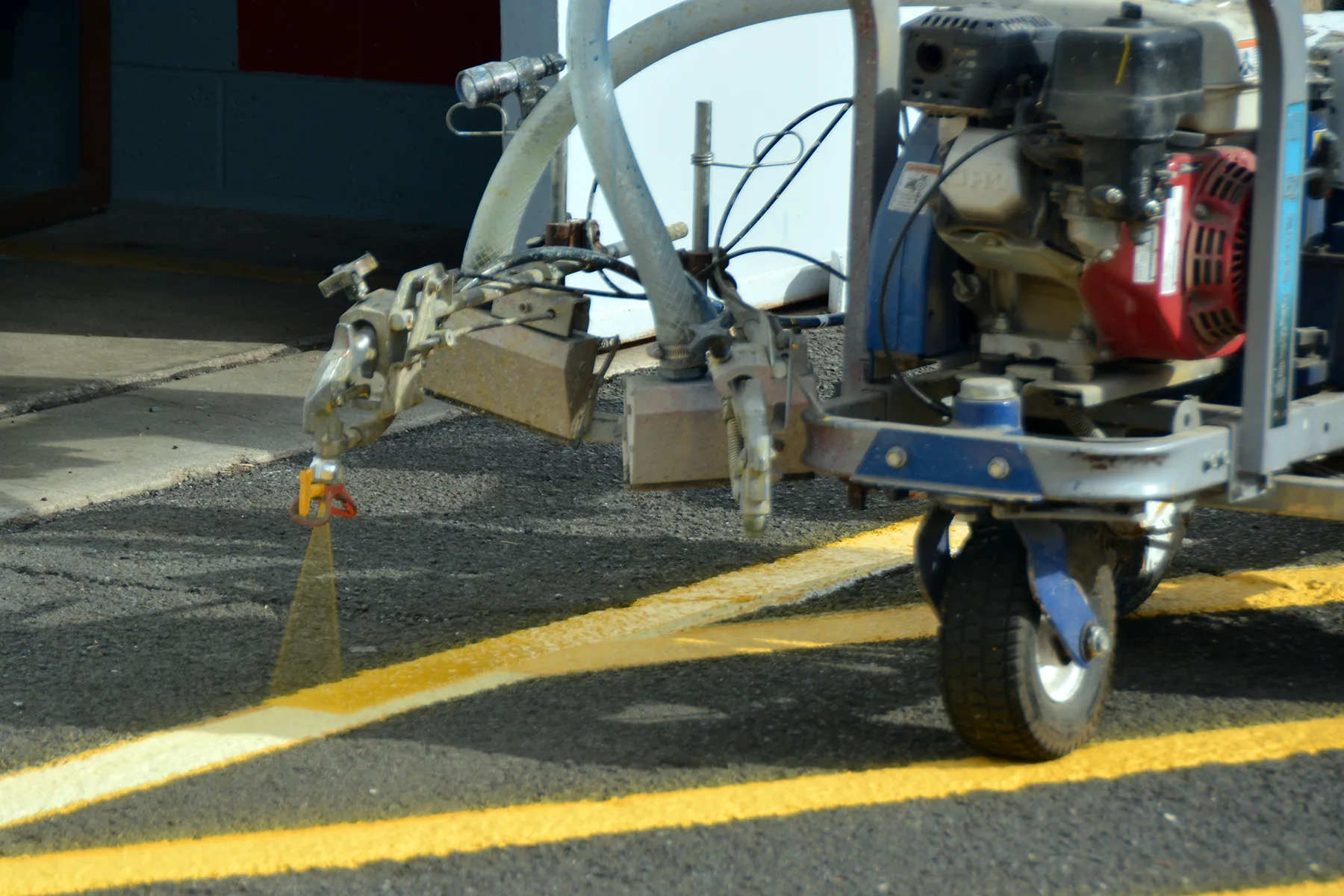
Graco LineLazer. Airless piston pump, built for high-production striping. The V and IV series run one or two guns and handle waterborne and solvent paint. A single-gun V 200HS fits smaller work; the 3900 and 5900 are the two-gun machines.
Graco publishes a dealer locator, and most metro areas have one. Suits crews striping 100 stalls or more per shift. Priced at the top of the walk-behind range, typically $4,000 to $9,000 new.
Titan PowrLiner. Also airless piston, also built for production work. Titan's 850 and 1650 models run two guns and hold pressure on long pulls. Titan and Graco are the two brands most often cited by contractors doing municipal and retail lot work.
Expect a similar price band to Graco, typically $3,500 to $8,000 new.
Wagner. Airless diaphragm and piston units at lower price points. The Wagner line suits short runs, small lots and waterborne paint. Diaphragm pumps do not hold pressure the way a piston does, so line quality fades on long pulls.
Suits a crew doing under 50 stalls per shift. Diaphragm units typically sell for under $2,500, and Wagner's larger piston units cost more.
Trusco. Walk-behind airless stripers with a simpler parts stack. Trusco units are common in the used market and are often the first machine a new owner buys. Fewer features, lower price, easier to service yourself. Used prices typically run $500 to $2,500.
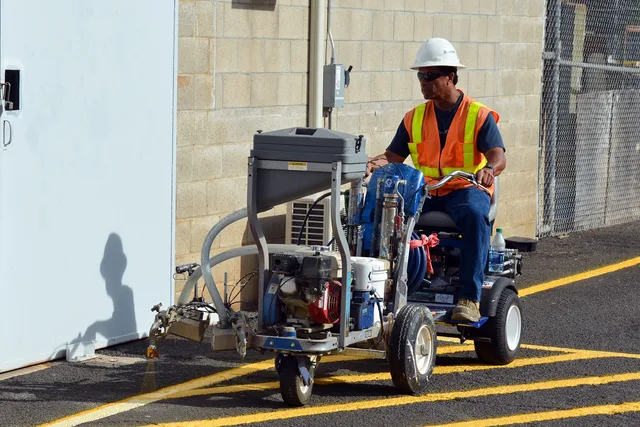
EZ-Liner. Walk-behind and ride-on options, sold direct. EZ-Liner markets to small and mid-size crews. Walk-behind units typically land under $4,000, and ride-on pricing runs higher.
The ride-on units change your training obligations and your traffic exposure.
How to compare two of them without a marketing claim
Score finalists on what you measured, not what you were told.
Score finalists on measured criteria
- Pump typepiston or diaphragm
- Line quality with your coating
- Production over a full row
- Cleanout time, timed by you
- Consumable cost from parts list
- Downtime risklocal parts and service
- Operator fatigue after the row
How to compare two of them
| Criterion | How you measure it | Why it decides the money |
|---|---|---|
| Pump type | Piston or diaphragm, read off the unit and the manual | Sets how the line holds at the end of a long pull |
| Line quality with your coating | Your own test pull | It is the product you sell |
| Production over a full row | Timed, with your operator | Determines jobs per shift |
| Cleanout time | Timed by you, at end of session | Predicts long-run reliability |
| Consumable cost | Parts price list | Recurs monthly, unlike the purchase |
| Downtime risk | Local parts and service | A lost night costs a customer |
| Operator fatigue | How the crew felt after the row | Shows up as line quality at hour six |
If two machines are close after that, buy the one your crew preferred. The person spraying at two in the morning has more effect on your line quality than any specification.
Before you look at a machine
- Write down the coatings you intend to run, then check the machine's documentation for what it handles. This step eliminates more candidates than any other.
- Write down the largest job you expect in one shift. Production capacity is only meaningful against a real job.
- Find out who services it within driving distance. A machine with no local parts route is a season-long outage waiting in it.
- Ask what wears out and how often. Any honest dealer will tell you.
With the machine in front of you
- Spray on your own pavement, with your own paint. Take a scrap slab or use a lot you control. A demonstration surface is chosen to flatter the machine.
- Check the line edge at the start and end of a pull. Anyone can produce a clean middle. The edges show pressure control.
- Change the line width. See how long it takes and whether it needs tools you do not have.
- Walk a full row. Fatigue is a real specification. A machine that fights you for thirty feet will beat you across a hundred stalls.
- Time a full cleanout yourself, with a timer. This number decides whether the machine gets cleaned properly at midnight or badly.
- Look at how the material system comes apart. Filters, tips and lines should be reachable without a workbench.
- Check what it takes to move and load. Weight, ramps and tie-down points matter. An excellent machine you cannot get off the trailer alone is a two-person machine forever.
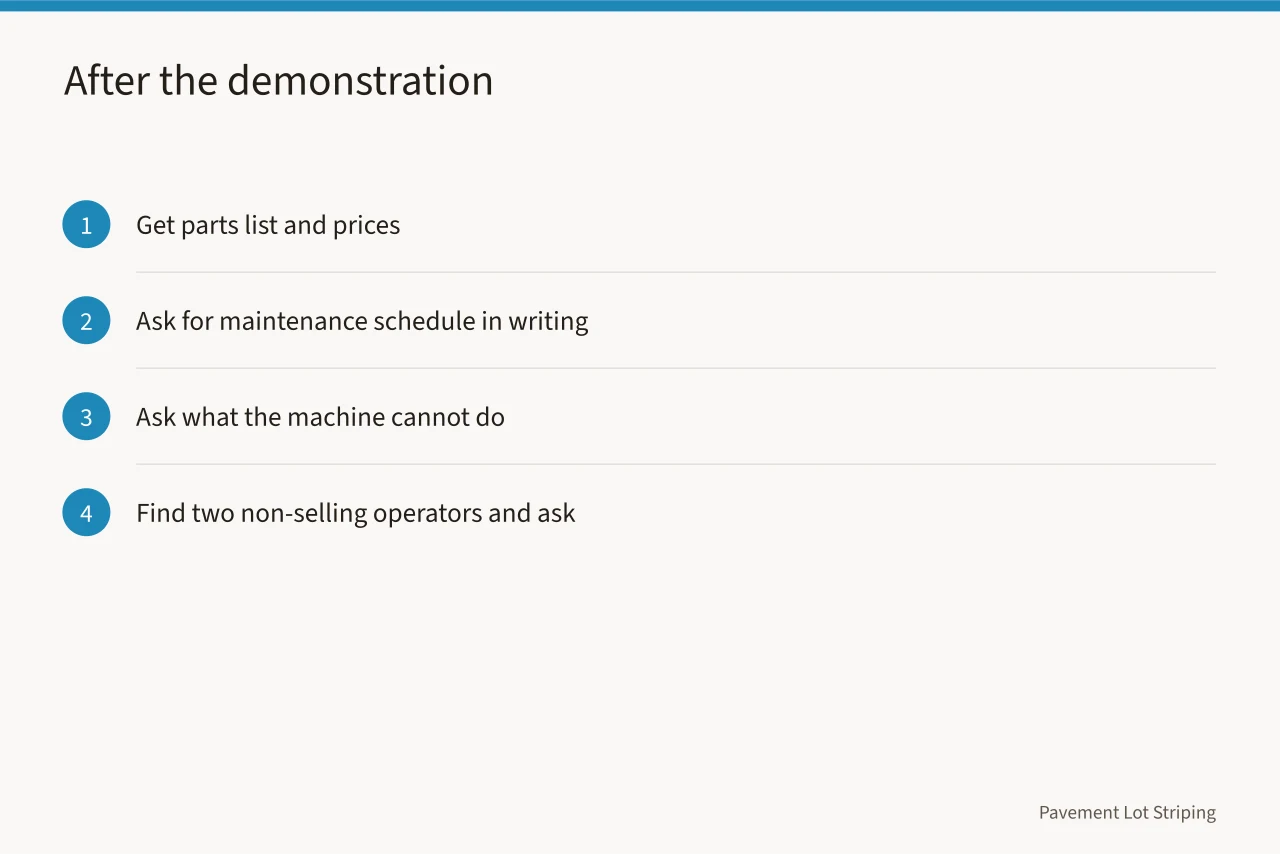
After the demonstration
- Get the parts list and the price of the parts. Compare consumables across candidates, not just purchase prices.
- Ask for the maintenance schedule in writing, then check whether you can follow it in season.
- Ask what the machine cannot do. The answer tells you how much the rest of the conversation was worth.
- Find two operators who use it and are not selling it. Ask what broke and how long they waited.
The full rig, by job phase, is in the equipment checklist for a new striping business. How the pieces work together on site is in the equipment and setup guide for striping work.
What the machine has to fit into
A striper is one item in a rig, and the rest of the rig decides how much of it you can use.
Washout and disposal. Whatever you buy will need flushing, and the flushings have to go somewhere lawful. Stormwater discharges are regulated and administered locally, as the EPA's overview of stormwater discharges from industrial activity describes.
Ask your authority what your route is, and buy the containment at the same time as the machine.
Who is allowed to operate it. Larger and ride-on equipment changes your training obligations and your traffic exposure. OSHA's material on building a safety and health program is the structure for handling that.
The competencies themselves belong in the hiring and training guide for striping crews, and anything requiring a license or permit sits in the licensing and compliance guide for striping contractors.
Keep the paperwork. Purchase documents, warranty terms and repair invoices all have to be substantiated later. The IRS guidance on records a small business should keep is the baseline for how long and in what form.
Common questions
Is a more expensive machine always better?
No, but a machine that is cheap because nobody services it locally is expensive in a way that does not appear on the invoice. Whether to buy new at all is worked through in the new versus used striping equipment cost guide.
Should I buy the brand the local dealer carries?
There is a real argument for it, and it is the parts route. Weigh that against the machine itself rather than treating it as decisive.
What if I cannot get a demonstration?
Then you are buying on a description. That is sometimes reasonable for a used machine at a low price and rarely reasonable for a new one.
How do I stop a salesman steering the test?
Bring your own paint, your own operator and your own timer, and run the checks in your own order. A seller who resists that has answered the question.