Guides
Setting up a parking lot striping business: the equipment checklist
Parking lot striping equipment mapped to the phases of a real job, with the setup sequence, the washout question, and the maintenance that prevents a lost night.
What to take away
- Load by job phase, not by category. A truck packed from a catalog list still ends up missing the item that stops the job. Every phase you cannot complete is a phase you will subcontract or skip.
- The striper is the smallest part of the decision. Layout tools and traffic control gear determine whether the work is right and whether the crew is safe.
- Surface preparation equipment is what makes a line last more than a season. It is also the equipment people leave at the shop.
- Washout is a regulated question in many places. Decide where the water goes before the first job, not on the first job.
- A machine that fails mid-job costs a reopening time, which costs a customer. Maintenance is a scheduling decision.
Match the kit to the phases of a job
A striping job has the same phases every time. List them, then check what you own against each one.
Job Phases and Equipment
- Closure: cones, barricades, signs, high-vis gear
- Preparation: blower, broom, scraper, degreaser
- Layout: measuring wheel, tape, chalk, crayon
- Application: striper, tips, stencils, shields
- Cure hold: same closure gear, longer
- Handover: camera, punch list, storage
Match the kit to the phases
| Phase | What happens | Equipment it needs |
|---|---|---|
| Closure | The area is emptied and protected | Cones, barricades, signs, high-visibility gear, tape |
| Preparation | Debris, dust and contamination removed | Blower, broom, scraper, degreaser, and water where allowed |
| Layout | The pattern is set out and verified | Measuring wheel, tape, chalk or string line, marking crayon, layout stakes |
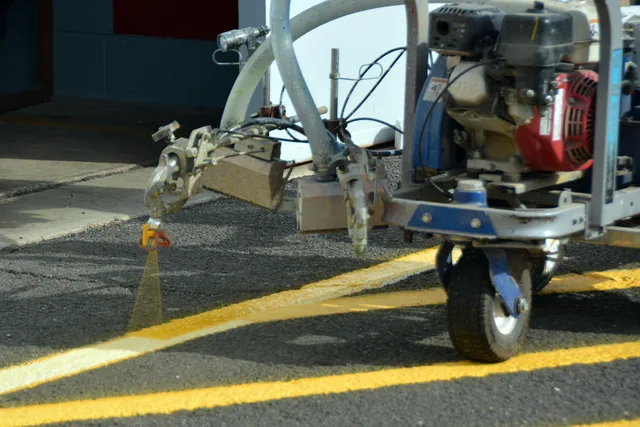
| Application | Material goes down | Striper, tips or nozzles, stencils, shields, hand liner |
| Cure hold | The lot stays closed while the coating sets | The same closure gear, for longer than people expect |
| Handover | The work is checked and recorded | Camera, punch list, and a way to store both |
The gaps in that table are the honest shopping list. A crew with a good striper and no layout tools produces straight lines in the wrong places.
Each phase ends with the question that phase is really answering. If you cannot answer it, you are not loaded for that phase.
Match the kit to the phases
- Closureif a delivery truck arrives at the wrong entrance at midnight, does the crew know what to do?
- Preparationcan you get the surface clean enough that what you apply will actually bond?
- Layoutcould you prove, tomorrow, what the lot looked like before you started?
- Applicationif conditions are marginal, can you decide from the data sheet instead of from hope?
- Cure holddoes the lot stay closed for as long as the data sheet says?
- Handoverin six months, can you show what you did and what it cost you?
Quantities make the list useful. A 20 to 30 space lot typically needs 10 to 20 cones and 200 to 300 feet of tape. A 200 space lot can need 40 or more cones and 500 feet of tape, plus a second person on the taper.
Carry two spare tips per machine in the sizes you run, and one spare filter per machine.
What the core kit costs
Typical US ranges, before tax. They move with brand, dealer, season and whether you buy new or used, so get a current quote.
What it covers
- Starter
- Layout tools, hand liner or aerosol applicator, cleaning kit, a few cones
- One operator
- Airless walk-behind striper, spare tips and filters, layout set, cones and barricades, washout container
- Small crew
- Larger airless or self-propelled machine, traffic control set, lighting, spares box
- Ride-on
- Ride-on striper and a truck-sized inventory of cones and signs
Typical range
- Starter
- $500 to $1,500
- One operator
- $3,000 to $9,000
- Small crew
- $10,000 to $20,000
- Ride-on
- $25,000 and up
Three things set the number: how much area you must close at once, how many coatings you run, and how much you buy used. Used walk-behind machines are common and often sell for less than half the new price. Check the pump and the parts supply before you pay.
The striper: what you are actually choosing between
Marketing describes machines by features. The decisions that matter are fewer than that.
Airless vs Simpler Stripers
Airless
- Speed
- Fast
- Line quality
- Sharp, consistent
- Cost
- Higher
- Forgiveness
- Less
- Best for
- Volume work
Simpler roll/gravity
- Speed
- Slower
- Line quality
- Less sharp
- Cost
- Cheaper
- Forgiveness
- More
- Best for
- Occasional small lots
How the material is pushed. Airless systems atomize the coating under pressure and lay a sharp, consistent line quickly. Simpler systems roll or gravity-feed material and are slower, cheaper and more forgiving. The first suits volume work; the second suits an operator doing occasional small lots.
What it will handle. Not every machine will run every coating. Thicker materials and two-part products have their own requirements, and a machine's own documentation states what it is built for. Check that before you take a job that needs a different product.
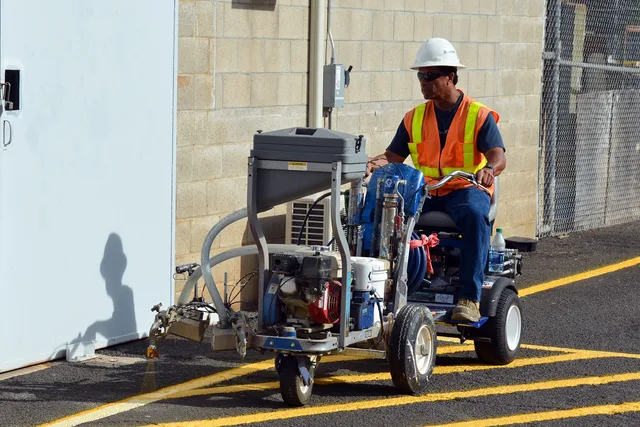
How it is guided. Walk-behind, self-propelled and ride-on machines are three different jobs for the operator. On a large lot the difference is fatigue, and fatigue is where crooked lines and overspray come from.
How long it takes to clean. This is underrated. A machine that takes an hour to flush at midnight will be flushed badly, and a badly flushed machine is tomorrow's clog.
Whether parts are available locally. A machine you cannot get a seal for is a machine you cannot use next week.
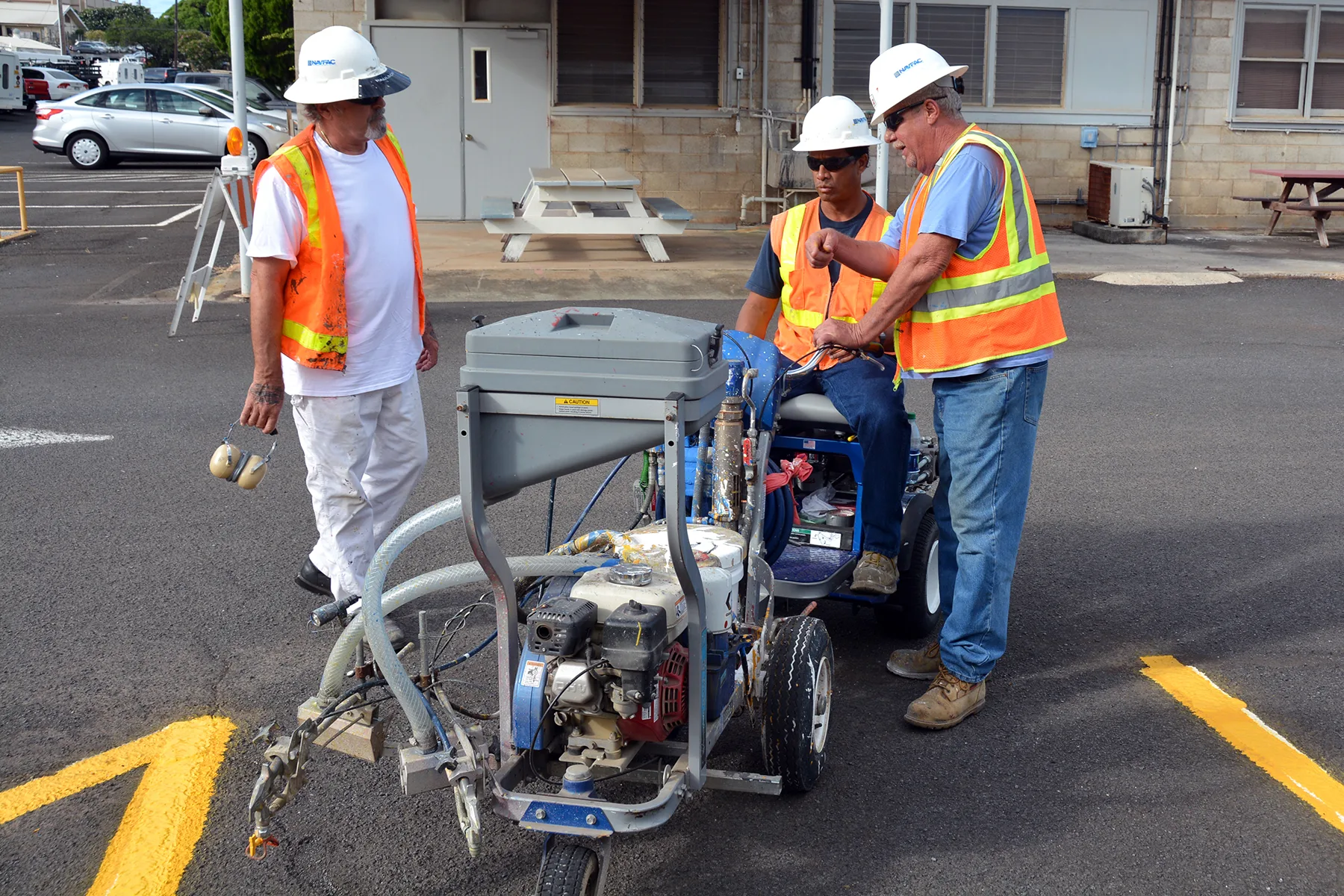
Examples by class: the Graco LineLazer 3400 and the Titan PowrLiner 6900 are airless walk-behind machines, the Graco LineDriver is ride-on, and the Newstripe EZ-Liner is an aerosol applicator. Models and specs change, so confirm the current sheet with a dealer.
Layout tools decide the job before the paint does
The line is the visible part. The measurement is the job.
At minimum, carry a measuring wheel and a long tape, a chalk line or string line, marking crayons or temporary paint, and something to record the existing layout before you disturb it. Photograph a lot before you touch it, every time. When a tenant later says there used to be more stalls, the photograph settles it in a minute.
Two layout points carry real exposure and deserve their own discipline. Accessible parking, including the number of spaces, their dimensions, the access aisle and the signage, is set by the ADA Standards for Accessible Design and by local building requirements.
Fire lanes are set by the fire code and the local fire marshal. Neither is a matter of matching what is already painted on the ground, and neither is something to take from a page like this one. Get the requirement from the authority, in writing where you can, before you lay out.
Traffic control gear is equipment
The serious hazard in this trade is not the coating. It is working in a space designed for moving vehicles, frequently at night, frequently while part of the site stays open.
Cones, barricades, advance signage, lighting and high-visibility clothing are part of the rig, not an accessory. The closure procedure is equipment too: a written sequence for closing an area, who watches traffic, and what happens when a driver ignores the cones.
OSHA's material on safety and health program management sets out how a small business builds that into a system. It should not be left to whoever is on site.
Setup at the site: a sequence that prevents rework
Do these in order. Skipping ahead is where the expensive mistakes live.
Site Setup Sequence
- Walk lot, note issues, photograph
- Confirm closurevehicles out, signs up
- Check surface dry and clean
- Verify conditions against product data sheet
- Set out and check layout before spraying
- Test machine on scrap area
- Apply, then protect during cure
- Walk with customer, record agreement
Setup at the site
- Walk the lot before unloading.Note failed areas, standing water, oil spots, and anything you will exclude. Photograph them.
- Confirm the closure.Vehicles out, signs up, cones set, entrance managed.
- Check the surface is dry and clean.Not just dry on top. A slab that was wet overnight can hold moisture in the texture.
- Verify conditions against the product data sheet.Air temperature, surface temperature and humidity all appear on the sheet, and it is the sheet that decides whether today works.
- Set out and check the layout before spraying anything.Measure twice on stall counts and accessible areas. Correcting chalk is free.
- Test the machine on a scrap area.Line width, pressure and edge quality, before the first stall.
- Apply, then protect.The cure hold is part of the job. Leaving cones out is not optional politeness.
- Walk it with the customer where possible, and record what was agreed.
Cleaning, washout and where the water goes
Every job ends with material that has to go somewhere: flush water, wash water, empty containers, sweepings.
Rinsing a striper into a storm drain is easy on a dark night and expensive afterward. Stormwater discharges are regulated, most industrial stormwater programs are administered by authorized states, and the rules for a contractor's washout vary by locality.
The EPA's overview of stormwater discharges from industrial activity explains the structure and points to who administers the program where you work. Ask that authority, and your material supplier, what your disposal route is, and set up the containment before you need it.
Build the answer into your equipment list: a washout container, a way to transport it, and a written disposal route the crew knows.
Maintenance that keeps a machine out of the middle of a job
Treat maintenance as scheduling rather than as housekeeping, because that is what it is: a failed pump at eleven at night costs you the reopening time you promised.
Maintenance that keeps a machine out
- After every job.Flush the system properly, clean tips and filters, check hoses for wear.
- Weekly in season.Inspect wheels, bearings and the frame. Test the machine before it goes to a job, not on arrival.
- Before the season.Replace wear parts on a schedule instead of on failure, and carry the ones that strand you: tips, filters, seals, a spare gun or wand.
- Keep the record.Machine hours, parts fitted, dates. This is what tells you whether a machine is nearing the end of its useful life rather than having a bad month.
That record has a second use. Equipment purchases, depreciation and repairs all have to be substantiated, and the IRS guidance on the records a small business should keep covers what supporting documentation looks like.
The three-question test before you leave the shop
Print it and work down it out loud. Tick items as they go on the truck, not as you remember owning them.
The three-question test
- Can I close the area I am working in, with everyone on site in high-visibility gear?
- Can I lay out the job, and prove tomorrow what the lot looked like before I marked it?
- Can I apply, then clean up, without leaving a washout with nowhere to go?
The items that cause a drive back are almost always small: a tip, a filter, a stencil, a can of layout marker. None looks like a missing machine, and each one stops a job.
Letting the service menu drive the purchase
Do not buy first and work out the services afterward. Decide which work you intend to sell, then buy the smallest kit that completes it. The services and packages guide for striping contractors defines the scope, and the startup and market guide for a striping business checks that the demand is really there.
For an outside review of a large equipment decision, the Small Business Administration's counseling and mentoring network includes Small Business Development Centers and SCORE volunteers who will look at a purchase plan without a commission at stake.
Common questions
What is the one piece of equipment new operators under-buy?
Preparation and traffic control gear. Both are unglamorous, and both decide whether the work lasts and whether the crew is safe.
Do I need more than one striper?
Not at first. You need a plan for what happens when the one you have fails, which is usually a relationship with another contractor rather than a second machine.
How do I know if a machine can run the coating I want?
The machine's documentation and the coating's data sheet both state it. Where they disagree, believe neither and ask the supplier before you commit to a job.
Is ride-on equipment worth it for a small operation?
It becomes worth it when lot size and crew fatigue start costing you quality late in a shift, which is a different threshold for every business. Track how your line quality changes across a long night before deciding.