Guides
Parking lot striping hiring and crew training
Parking lot striping hiring: find candidates, define crew roles, train for independent tasks, complete hiring paperwork, and plan seasonal retention.
What to take away
- Define the crew by what each person may do unsupervised. Job titles teach nobody anything.
- The competency that matters most is not spraying. It is judging whether a surface and the conditions are ready.
- Night work is a different job from day work, and it should be hired for and trained for as one.
- A seasonal trade loses people in the off season unless the off season is planned. That is a business decision, not a personnel problem.
The roles on a striping crew
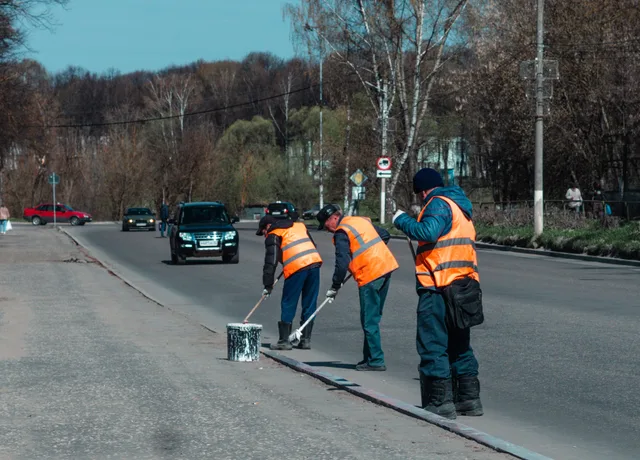
Small crews wear several hats, which is fine as long as everyone knows which hat they are wearing at any moment. For parking lot striping hiring, start by defining those responsibilities and the work schedule candidates are being asked to take on.
Finding and selecting candidates
Recruit through several channels: Indeed, local community or technical colleges with construction or maintenance programs, workforce centers, staffing agencies, employee referrals, and local union hiring halls where available. Describe the outdoor work, overnight schedule, seasonal nature of the job, and physical demands in the posting rather than saving them for the interview.
Screen for reliability, comfort working outdoors and at night, careful measuring, and willingness to follow safety procedures. Ask how a candidate would respond if a vehicle entered a closed work area or if the surface conditions seemed unsuitable for application. Check references with the candidate’s permission, and review driving records only when driving is part of the job and applicable law permits it.
A short working interview can be a supervised, paid task on a real job. Observe whether the candidate follows instructions, uses protective equipment, notices hazards, and stops to ask when unsure; pay for all time worked.
| Role | What it owns | Where it goes wrong |
|---|---|---|
| Crew leader | The closure, the go or no-go decision, the release of the lot | Being the fastest operator rather than the best decision maker |
| Layout | Measuring, setting out, verifying against the pre-work photographs | Assuming the existing lines are correct |
| Applicator | Machine setup, line quality, stencil work | Speed at the cost of edges late in a shift |
| Preparation | Blowing, sweeping, contamination treatment | Shortened when the job runs late |
| Traffic and site control | Cones, signs, watching for vehicles, keeping the public out | Treated as the job for whoever is least experienced |
That last row is the one to change if you change nothing else. On a live lot, the person watching traffic is doing the safety-critical job, and giving it to the newest person because it looks easy has the logic backwards.
What each person must be able to do alone
Write your crew structure as a list of things a person may do without supervision. That list is the real organization chart, and it makes promotion concrete.
A reasonable progression looks like this.
Level one, supervised on everything. Can set cones to a pattern, sweep and blow to a standard, carry and handle material safely, and knows when to stop and ask.
Level two, works unsupervised on defined tasks. Can run the machine on straight runs, place stencils, and complete preparation to the written tolerance.
Level three, can prepare a job. Can lay out from an existing layout, verify it against photographs and a drawing, read a product data sheet, and judge whether conditions are inside its range.
Level four, can run a job. Can plan and execute a closure, make the go or no-go call, decide when the lot may be released, and handle a customer on site.
Nothing about that list is about years of experience. It is about specific things a person can be observed doing.
The training path, in order
Teach in this order, because each stage protects the next.
- Safety and site control first.Before anyone touches a machine, they should be able to set and manage a closure, and know what to do when a vehicle enters it.
- Preparation second.It is the least glamorous stage and the one that determines whether the work lasts. Teaching it early signals that it matters.
- Layout third.Measuring, verifying, and photographing before anything is disturbed.
- Application fourth.Machine setup, line quality, stencils, touch-up.
- Judgment last.Reading a data sheet against the conditions, deciding to stop, deciding when to release a lot.
Most operations do this in exactly the reverse order, teaching people to spray on the first night and safety by accident.
Write standards a tired person can follow for every stage, and train crews on the actual equipment they will use: cones and other traffic-control devices, blowers, measuring and layout tools, striping machines, and stencils. Use product data sheets for handling and application requirements, and OSHA construction safety materials as a supplement to site-specific safety instruction. Check finished work against a consistent quality standard, including layout accuracy, line appearance, cleanup, and whether the lot is safe to reopen.
Night work is a different job
A crew that works overnight is doing something meaningfully different from a day crew, and it should be hired and trained for accordingly.
Fatigue changes line quality in the second half of a shift. Visibility changes what a person can see on the surface and what a driver can see of them. Sleep patterns affect who can sustain the work at all, and a person who is excellent at ten in the morning may not be at three in the morning.
Three practices help. Recruit explicitly for the hours rather than mentioning them at the end of an interview. Build the shift so that judgment-heavy checks happen when people are freshest. And pay for the hours honestly, which is both fair and the only thing that keeps a night crew.
Seasonality and the retention problem
In freeze climates the work stops, and good people cannot wait unpaid for spring. This is the most predictable staffing problem in the trade, and it is a business design question rather than a hiring one.
The options are limited and worth deciding deliberately.
Carry a small core through the winter on other work, if you have any: interior warehouse marking, signage, maintenance, equipment refurbishment. Accept the loss and rehire each spring, which costs you the training investment annually. Or build a relationship with a complementary seasonal business and share people between opposite seasons.
Whichever you choose, tell candidates the truth at hiring. The turnover that hurts is not the person who leaves in November. It is the person who leaves in June because they were surprised in November.
What the law asks once you have a crew
Employment rules apply from the first hire, and this trade has two features that make them harder than average: overnight hours and variable schedules.
The Department of Labor’s compliance assistance for new and small businesses is a starting point for federal wage-and-hour obligations, including time records and rules for younger workers. For each employee, complete and retain Form I-9 as required, collect Form W-4 for federal withholding, and report new hires to the state new-hire reporting program. E-Verify is not universally required; use it when a federal contract or applicable state law requires it, or if you choose to participate under its rules. State wage-and-hour requirements may be stricter; in California, the California Labor Commissioner’s Office, also known as the Division of Labor Standards Enforcement, handles these matters, while other states have their own agencies.
Hiring practice itself is also governed. The Equal Employment Opportunity Commission's small business resource center sets out what small employers need to know about non-discrimination in recruiting, hiring and managing people, which matters as much for a three-person crew as for a large firm.
There is no single nationwide striping license that applies to every job. Requirements depend on the state, locality, and scope of work. For example, California contractors can check with the Contractors State License Board about licensing requirements; elsewhere, start with the state contractor licensing board or the state agency that handles contractor licensing, and check local permitting requirements too.
Crews also handle material that has to be disposed of lawfully, so washout and waste routes are a training item, not just a policy. The EPA overview of stormwater discharges from industrial activity explains the federal framework; check with the relevant state environmental authority for requirements that apply to your operation and site.
Paying for skill you can verify
Tie pay decisions to the unsupervised-task list rather than to time served. Set a pay band for each responsibility level, then review it against local labor-market information and the actual duties, schedule, and experience required. A person who can run a job has different responsibilities from a person who has only learned defined tasks, even if both have worked for the business for the same amount of time.
Use the Bureau of Labor Statistics Occupational Employment and Wage Statistics tool to look up published wage estimates by occupation and area. Choose comparable outdoor or construction occupations carefully: the estimates are a local reference point, not a striping-specific wage or a substitute for setting pay bands for your crew’s actual responsibilities.
Check the full labor cost against your own job records. Include paid work time, travel, setup and cleanup, materials, equipment, and overhead, then compare those costs with the revenue from the completed work before deciding whether a pay band and crew size are sustainable.
The services you offer determine which skills to hire for: restriping requires application and preparation skills, while layout changes add measuring and verification work. Crew size should reflect booked work, seasonal demand, shift length, and the capacity of your equipment, not just the number of people available to hire.
Common questions
Where do good candidates come from in this trade?
Candidates with outdoor work experience, reliable attendance, and careful measuring skills can be good prospects. Recruit through job boards, local training programs, workforce centers, staffing agencies, employee referrals, and union hiring halls where available. Prior striping experience is useful and is not the strongest predictor.
How long does it take to train someone to run a job?
Longer than a season for most people, because the judgment stage needs exposure to conditions that only arrive over time. Someone can be genuinely useful within weeks.
Should I hire seasonal or year round?
Decide the model first. Hiring year round without winter work is a promise you will break, and hiring seasonally without saying so is the same promise made quietly.
Is a working interview reasonable?
A short, paid, supervised task on a real job tells you more than any conversation. Pay for all time worked, give the safety induction first, and observe whether the candidate follows instructions, spots hazards, handles equipment carefully, and asks for help when needed.
What should I do about a good operator who ignores safety rules?
Treat it as the serious matter it is, immediately and in writing. On a live lot at night, tolerating it once makes it the standard.